

What causes ADHD cannot be traced to one decision, experience or behaviour. The available evidence on ADHD points towards a complex combination of genetic influences, brain development and other factors that may affect the likelihood of the condition developing.
The absence of a single, straightforward explanation can sometimes leave individuals or families wondering whether they have done something wrong. ADHD is not caused by laziness, poor discipline or a lack of effort and understanding the evidence can help replace blame with a clearer view of the condition.
Why ADHD Is Considered a Neurodevelopmental Condition
ADHD is a neurodevelopmental condition affecting attention regulation, activity levels, impulse control and executive functioning. These patterns begin during childhood, although they may not be recognised until adulthood, when work or other responsibilities place greater demands on concentration and organisation.
Executive functioning includes mental processes involved in planning, working memory, starting tasks, managing time and regulating behaviour. Difficulties in these areas can affect everyday life even when someone understands what they need to do and is making a genuine effort to do it.
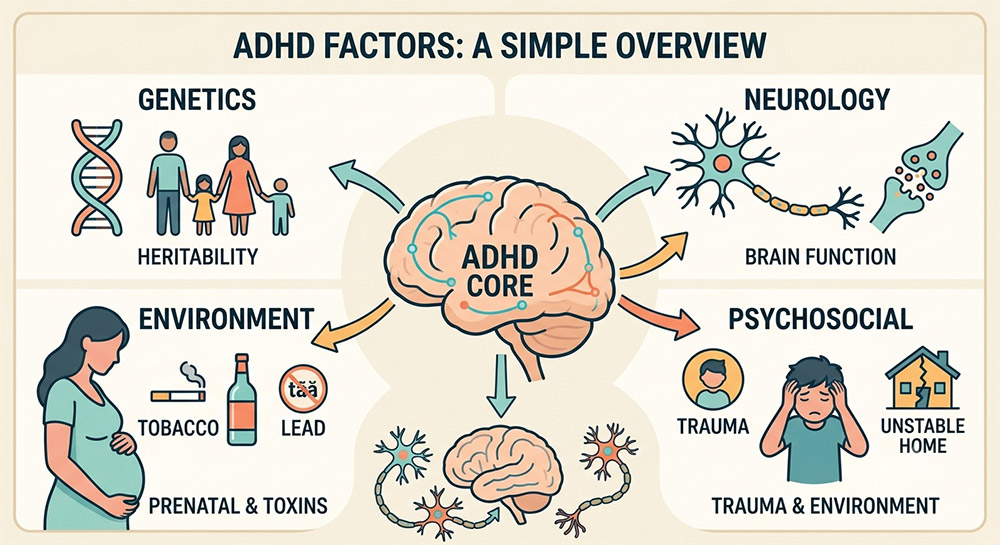
ADHD can appear in several members of the same family without affecting each person in exactly the same way.
The Role of Genetics in ADHD
ADHD tends to run in families and genetic evidence shows that inherited factors make a substantial contribution to the likelihood of developing it. Twin and family studies put the heritability of ADHD at roughly 74 to 80 percent, higher than for most psychiatric conditions, although this is a population-level estimate rather than a prediction for any individual. A parent, child or sibling may have ADHD or recognise similar traits, although those traits can look different and have a different effect on each person.
No single gene explains ADHD. It is thought to develop through a combination of genetic influences, which is why several relatives may have ADHD without sharing the same presentation or experiencing the same level of difficulty.
ADHD and Brain Development
Neuroimaging studies have found average differences in the structure and activity of brain regions involved in attention, inhibition, motivation and executive functioning. These findings may help explain why ADHD can affect planning, task initiation, working memory and the ability to regulate attention or impulses.
The findings apply across groups and cannot show whether one individual has ADHD. A routine brain scan cannot confirm the condition, as diagnosis is based on clinical assessment, developmental history and the effect of symptoms on everyday functioning.
Prenatal and Early-Life Factors Linked to ADHD
Research on ADHD risk factors has found associations with several prenatal, birth and early-life factors, including premature birth and certain environmental exposures. These are possible risk factors rather than explanations for every case, and an association does not prove that one event caused ADHD in a particular person.
The relationship between genetics, early development and environment is complex. Many people with ADHD have no single known exposure or experience that explains the condition, while most people exposed to a possible risk factor will not necessarily develop it.
Current evidence points towards a combination of genetic, developmental and environmental influences rather than one simple cause.
Parenting, Diet and Screen Time Do Not Provide a Simple Explanation
ADHD is not caused by poor parenting, weak boundaries or a failure to teach a child how to behave. Parenting approaches and household structure may influence how manageable certain difficulties feel, but this is different from causing the underlying neurodevelopmental condition.
Sugar, gaming and screen use have also not been established as single causes of ADHD. They may affect sleep, routine, energy or concentration in some circumstances, but those effects should not be confused with evidence that they created the condition.
Why Understanding the Cause Does Not Replace ADHD Assessment
A person does not need an obvious family history or known risk factor to have ADHD. Equally, a relative with ADHD or exposure to an associated factor cannot confirm that the same condition is responsible for someone else’s difficulties.
Assessment instead considers when the difficulties began, how they appear across different settings and the effect they have on everyday functioning. At Mindful Space, we explore current concerns, earlier patterns and other possible explanations to build a fuller clinical picture rather than attributing ADHD to one event.
Moving Beyond Blame Around ADHD
Current understanding points towards a combination of genetic, developmental and environmental influences. It does not support the idea that ADHD develops because someone did not try hard enough or because a parent made one particular choice.
A clinically informed explanation can help individuals and families understand why certain difficulties may be occurring without assigning blame. It also provides a more constructive starting point for exploring whether assessment and support may be appropriate.
Book an Online ADHD Assessment in Ireland
Recognising a possible risk factor cannot confirm whether someone has ADHD. If difficulties with attention, organisation, activity levels or impulse control are affecting everyday life, Mindful Space provides structured online ADHD assessments across Ireland to explore the full pattern and guide appropriate next steps.
Frequently Asked Questions About the Causes of ADHD
Is ADHD inherited from the mother or father?
Genetic influences associated with ADHD can come from either side of a family. Its inheritance is complex, so it cannot generally be attributed to one parent or traced through a single, predictable pattern.
Will a child develop ADHD if one parent has it?
Having a parent with ADHD may increase a child’s likelihood of developing the condition, but it does not make diagnosis inevitable. The child may not have ADHD or may experience a different combination of traits from their parents.
Can ADHD skip a generation?
ADHD may appear to skip generations when some relatives have milder or less visible traits or were never formally assessed. Family members can also differ considerably in how their difficulties present and how much they affect daily life.
Can trauma cause symptoms that resemble ADHD?
Trauma can affect attention, sleep, behaviour and emotional regulation, creating difficulties that may resemble or intensify ADHD symptoms. A careful assessment can explore when the difficulties began and whether ADHD, trauma or a combination of concerns may be relevant.
Can poor sleep cause ADHD?
Poor sleep is not considered a simple cause of ADHD, but it can produce difficulties with concentration, memory and emotional regulation. It may also make existing ADHD symptoms harder to manage, so ongoing sleep concerns should be considered within the wider clinical picture.
Does premature birth mean a child will develop ADHD?
Premature birth has been associated with an increased likelihood of ADHD, but most individual outcomes cannot be predicted from this factor alone. A child’s development should be considered as a whole rather than assuming that one aspect of their birth history determines a future diagnosis.
Can ADHD suddenly develop in adulthood?
ADHD begins during development, even when it is not identified until much later. Adult responsibilities can expose long-standing difficulties that were previously less visible, supported by external structure or managed through coping strategies.
Can someone have ADHD without a family history?
A known family history is not required for ADHD to be present. Relatives may also have unrecognised traits, may never have undergone assessment or may not experience the condition themselves.
Is there a genetic or medical test that confirms ADHD?
No routine genetic test, blood test or brain scan can independently confirm ADHD. Diagnosis relies on a comprehensive clinical assessment of developmental history, current symptoms and their effect on daily functioning.
Does Autism cause ADHD?
Autism does not cause ADHD, although the two neurodevelopmental conditions can occur together. When traits of both may be present, assessment should consider the person’s wider developmental, sensory, communication and attention profile.